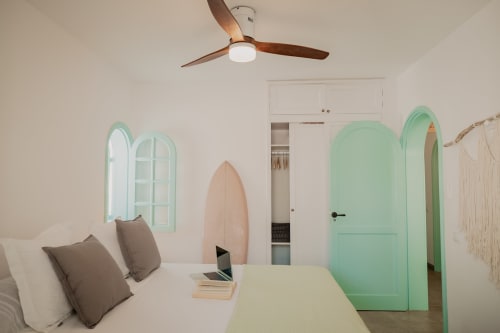
Caleta de Fuste Fuerteventura
Caleta de Fuste is an attractive town on the
East coast of Fuerteventura, also known as Castillo, the town
has expanded rapidly with tourism, offering a variety of nightlife
and entertainment. Caleta de Fuste has a very central location
on the island making it an ideal base to explore the rest of Fuerteventura
plus its location, just 10 minutes from the airport make it perfect
for a holiday visit.
The villas are located just 5 minutes
drive (approx. 2km) from the town centre of Caleta de Fuste and
a 40 minute drive from the fantastic beaches and sand dunes of
Corralejo or the superb windsurfing beaches in the south. Fuerteventura
boasts miles and miles of breathtaking coastlines and scenery
so exploration is a must.
The Fuerteventura Golf
Course, Caleta de Fuste
Caleta de Fuste is the site of the first golf course in Fuerteventura
which opened the end of April 2002. The course consists of 18
holes and is a par 70 with a distance
of 6049 meters from the men's championship tees, with
two loops of nine holes starting and finishing at the clubhouse.
There are three large pretty lakes connected by a stream, all
of which come into play. The course is basically flat with the
exception of the 17th and 18th holes. The 17th, a par 5, climbs
gently up to a well protected green and the 18th, a par 4, is
downhill returning to the clubhouse. Buggy paths connect all holes.
The practice facilities include a 50 bay driving range, a large
putting green and a second green for chipping and bunker shots.
The clubhouse includes a large pro-shop, changing rooms with lockers
available, various bars, cafeterias and restaurants. There is
also an outside terrace and garden area.
Other Places of Interest in Fuerteventura
Corralejo, once a small fishing village,
it has grown into a lively colourful town. There are white sandy
beaches where you can 'drop down' and soak up the Canarian sunshine.
Most of the shops, bars and restaurants run along the main street
which leads on to the harbour overlooking the sand dunes. These
dunes (a protected nature reserve) lie just beyond the town and
spread for miles along the east coast. You can still find some
of the original houses in the town, simple and quaint but most
have now been transformed into shops and restaurants. Corralejo
caters for all ages and there's a wide variety of things to do,
from water sports , tennis, glass bottom boat trips, ferry trips
to Lanzarote and Lobo, Jeep Safaris, Island tours, Mountain biking,
Motorbike tours etc…
Costa Calma, In 1984 Costa Calma had its
first major tourist boom, despite its incredible white beaches.
Today the resort is fully up and running with plenty of bars,
restaurants and hotels. The main road into the resort is lined
with palm trees and Canary pines. The highlight of Costa Calma
is the long sandy beach of Playa Barca to the southwest. It's
always easy to find a quiet, sheltered spot here even during
peak season. Windsurfers are particularly fond of this beach
because of the strong off shore winds during the summer months.
El Cotillo, This small rustic fishing village
is dedicated to the virgin of good travel (Virgin de Buen Viaje)
these words can be seen painted on the cliffs in the old harbour.
Cotillo is a peaceful place offering some good restaurants, bars,
a few shops and more recently, lots of new accommodation. With
fantastic beaches and lagoons lying south of the little harbour
town, Playa del Castillo is one of the nicest beaches in this region.
Further to the south are the beaches of Playa del Ajibe de la Cueva
and the Playa del Aguila, both wild and remote. This area is truly
the surfing and windsurfing Mecca of the island. South of the harbor
is the Fortaleza del Tostón. This round shaped fort was
built in the late 1790's to defend against invading pirates. The
old harbour is the most picturesque part of town and it is here
you'll find most of the bars and restaurants.
Morro Jable, Once a small sleepy fishing village
with only 200 inhabitants, Morro Jable has something for everyone
with the miles of golden beaches and clear blue seas, shops, bars
and restaurants. The old village still remains intact and there
is a quaint harbour in the west of the town, used by local fishermen
and yachtsmen where you can escape the hustle and bustle. Some
of the beaches here are the longest and most beautiful in the Canary
Islands stretching 35km and there's plenty to do for the water
sports enthusiast from jet skiing to windsurfing. It´s also
possible to take a jet foil from here to Gran Canaria.
Betancuria lies in a picturesque valley next to a dried up stream
that flowed up until the 16th century. Founded in 1405 by the Norman
conqueror Jean de Bethencourt, it has plenty of history. Designed
to protect the capital from pirate attacks, in 1593 the pirate
Jaban penetrated Betancuria and reduced everything including the
Santa Maria church to a pile of rubble. The church was rebuilt
in 1691. Betancuria was capital for quite some time until the local
people started moving away from the town due to lack of arable
land. In 1834 the capital was changed to La Oliva. On the main
street running through the town is the Casa Museo Arquebiologico,
with the famous cannon. The building encases a collection of important
archeological finds. These include fertility idols, an idol frieze
that was discovered near La Oliva, and many farming implements.
The church has been fully restored and open to the public and there's
also a church museum. At the Casa Santa Maria you can see local
artists at work and purchase some of the hand made products from
the local shop.
Antigua is one of the oldest villages on Fuerteventura, was built
in the 18th century. Antigua was once the capital of Fuerteventura
but only for 1 year! The lovely church “Cruz de los Caldos”,
built in 1785, dominates the town and is surrounded by trees and
shrubbery. Antigua also has a fully restored windmill, now a cultural
centre containing a craft shop with local handicraft and art for
sale. The main economy is based on agriculture and fishing in the
nearby port of Pozo Negro. Antigua is also famous for it's market.
Cofete sits in one of the most isolated corners of the island.
The only access is by a small dirt track, not for the feint hearted
but the views are fantastic! As you pass the highest point between
the peaks of Pico de la Zara and Frail you are rewarded with spectacular
views of the north and south of the island. Another place worth
a visit in the area is villa winter - of Gustav Winter. This house
stands on a fenced piece of land the same shape as Fuerteventura
and the position of the building on the plot is the same as its
location on the island. Originally designed as a manor house, the
house of winters was intended to ensure land cultivation in that
region. Many people used to live there in almost total isolation
at a time when agriculture, animal farming and cheese making were
only just developing.
Gran Tarajal is one of the largest towns on the island, it owes
success to the fact that all of the islands tomatoes were once
exported from here. From the harbour it's possible to view all
of the streets and small alleys that are built into the hillside.
Here, you can watch the local fishermen at work or stroll along
the beach promenade. The town has a beautiful fountain with six
sea horses spouting water, situated in the middle of a shady oasis
of tall palm trees beside the 20th Century built church.
La Lajita Zoo is located between Tarajalejo and La Cuesta de La
Pared ,essentially a small fishing village with a handful of excellent
fish restaurants and bars in the village but the main attraction
is the 'Oasis de Los Camellos' zoo. A small selection of animals,
horse rides, parrot shows and a bar set under the shade of palm
trees and camel safaris and a Cactus Garden situated next door.
Lajares, Upon entering the village is the football
stadium that was built in 1990. The town also has a 'lucha canaria'
area, a form of wrestling that's very popular throughout the Canary
Islands. The main attraction has to be the local laceshop 'Artisania
Lajares' where you can watch the local women making lace and embroidery.
In the southern part of the town are two windmills next to the
church. One of these windmills was still in use up to 20 years
ago, and the owner and his wife still live there.
La Oliva was the political centre of Fuerteventura
from the early 17th to mid-19th century, some of the original buildings
are still standing today. In the centre of the town stands the
main church “Parroquiade
Nuestra Señora de Candelaria” a pretty little church
with a square bell tower visible for miles around, and a finely
carved wooden door. Inside the church you can see the mudejar ceiling,
a large painting of The Last Judgment, a baroque altar painting
by Juan de Miranda (1723-1805), and some fine trompe 1'oeil work.
The grandest part of town is the townhouse, “Casa de los
Coroneles” (house of colonels) which was where the military
governors of the islands used to reside. Above the main entrance
is the family coat of arms and wooden balconies decorated with
carvings. It has been said many times that the building has 365
windows, but this comes mainly from comments made by the poor who
expressed their opinions on the wealth of the people who were living
in the house claiming they had "as many windows as there are
days in the year". This is currently under restoration.
La Pared is situated on the north west coast of Jandia, La Pared
gets its name from the stone wall which allegedly ran from East
to West coast of the island dividing Fuerteventura in two halves
(Maxorata and Jandia). The town's only water supply comes from
the natural caverns in the mountains. There´s not a great
deal in the village, but you can find some great restaurants in
the area, also a golf practice course with tee offs covered in
artificial grass, and a horse-riding school. A great place to spend
a family day out is at the restaurant Bahia Mar with panoramic
views of the coast, a fully equipped swimming pool with water slide,
and children's playground.
Islote de Lobos, The protected nature reserve
of Islote de Lobos is just a short boatride from Corralejo, an
experience of serenity and privilege is the Protected Nature Reserve
of Lobos, home to plants and birds not to be found anywhere else
on the planet. Lobos was home to dense populations of seals - 'lobos
del mar' (Sea Wolves) but today it is home to different seabirds
that nest in the cliffs and rocks. The European Community Commission
has now included Lobos in the Spanish areas of special protection
for birds. The highest point is the Montaña La Caldera (The
Cauldron Mountain) at 127mts. Other notable features are the dilapidated
Los Edificios Volcánicos
(Volcanic Buildings) on the north coast, Los Hornitos (The Little
Ovens), el Salador de El Faro (The Lighthouse Saltmarshes), el
Jable de La Cocina (Jable of the Kitchen), el Malpais del Interior
(the Inner Badlands) and la Hoya de Las Lagunitas (The Valley of
the Little Lagoons).
Pajara, The little town of Pajara is very picturesque, once voted
the 8th prettiest village in Spain, it has a large amount of pretty
trees and bushes, lawns and a freshwater swimming pool. Just outside
the Town Hall sits a fine old disused 'camel driven' waterwheel,
and close to that is the leafy church square. The church (Iglesia
Nuestra Senora de la Regla) was built between 1687 and 1711 and
is one of the most beautiful on the island, with its ornately decorated
doorway. The Virgin standing at the altar was brought to the island
by a wealthy emigrant. Not far from Pajara is the small quiet town
of Tuineje. It was close to here in 1740 that 37 farmers armed
with just five muskets and various agricultural implements battled
against a 50-man English pirate troop that were carrying guns and
cannon. The battle took place on the Montaña de Tamacite
and surprisingly, even with their lack of weapons, the local people
won the battle attacking the English before they had time to reload.
Thirty Englishmen and five local Fuerteventurans' (or Majoreros)
were killed that day, and two captured the cannon that can still
be seen in front of the museum in Betancuria today. This scene
has also been immortalized in a painting in the church 'San Miguel
Arcangel'.
Puerto del Rosario was founded in 1797, the town has been the
capital since 1860. Named Puerto de Cabras (Port of goats) until
1957, the town developed into an important port during the 19th
century. The church in the centre of 'Puerto' is dedicated to the
patron saint 'Virgin del Rosario'. Puerto is an industrial area
and does not really cater for tourism, although many people still
visit the town to do some shopping. Recently the harbour promenade
was rebuilt. The harbour area is the oldest part of town and it
is from here you can find all of the small alleys lined with old
Canarian style houses. There is one place worth a visit, the home
of the former exile poet Miguel de Unamuno, which is now a museum.
Tefia, In the small village of Tefia, La Alcogida has been rebuilt.
Described as an Eco museum based upon an old Canarian village giving
an insight into how life was before tourism. There are eight small
houses including a main farm house where you can see examples of
old ovens, milling wheels and live demonstrations of lace making,
basket weaving, pottery, cheese making, carpentry and a blacksmith.
The 'village' grows its own Canarian crops. The population of the
island was halved after the 2nd World War due to a 7 year drought.
Camels were extremely important to farmers as work animals and
there is still a camel breeding farm on the island, selling camels
all over the world for their strength and durability.
Tindaya, Once regarded as a very religious place
this village, the protected zone of Tindaya sits at the foot of
the 401m mountain of the same name and considered sacred with more
than 100 carvings of 'feet' (podomorphs) in the smooth rock. These
strange carvings which sit at the very top of the mountain, were
only discovered in 1978. The feet are said to ward off evil spirits,
and on a clear day it's possible to see Mount Teide, the highest
mountain/volcano on Tenerife. Old inhabitants used to see Mount
Teide as the residence of the devil and all the carvings face in
that direction.
Vega de Rio Palma, This valley and its village
is one of the most beautiful areas on the island. The impressive
church (Nuestra Señora de la Peña) was built in 1666
and is surrounded by greenery. The white and clay coloured buildings
perch on the edge of the stream with little terraced fields in
between. Until the 16th century, there was a mountain stream that
flowed through the village. In the 15th Century, Jean de Bethencourt
and his army marched up this stream. Today the area is totally
dried up and only during the winter months when there is the odd
downpour does the stream fill the reservoir. Just beyond the dam
is the tiny white chapel (Ermita de Virgin de la Peña).
At the altar hangs a painting showing the discovery of a statue
of the saint that now stands at the main church. This statue was
brought to the village by Jean de Bethencourt. Shortly afterwards
the church was totally destroyed by 'Jaban' the pirate in 1593
but the statue was hidden so well that it was only rediscovered
in the 17th century.
The Guanches,
Fuerteventura, like the rest of the Canary Islands, was inhabited by primitive
pagan people before the invasion of Europeans. Most Canarians call their ancestors
'Guanches' although strictly speaking this refers to a specific tribe from
Tenerife. 'Mahorero' is still used today to describe the people of Fuerteventura
and comes from the ancient word 'mahos' meaning a type of goatskin shoe worn
by the original inhabitants. Analysis of prehistoric remains seem to indicate
that these people arrived from North Africa, and this is mirrored by many linguistic
similarities between pre-hispanic place names, words and the language of the
Berbers in North Africa. Fuerteventura was known as Herbania, possibly a reference
to it’s abundant plant-life in ancient times, although hard to believe
looking at it’s barren landscape but more likely from the Berber word
'bani' meaning wall. A low wall spanned the narrowest width of the island,
from La Pared over to the east coast, dividing it into two kingdoms. The north,
Maxorata was ruled by Guize and Jandia in the South, by Ayoze. Although ostensibly
ruled by these two kings, they in turn took advice and guidance from a mother
and daughter team of two priestesses, Tibiabin and Tamonante. It is believed
that it was a polygamous society, with each woman having an average of three
husbands. They lived on fish, shellfish, goats’ meat, milk and cheese,
and ‘gofio’ a finely ground toasted barley flour. They lived in
caves or semi-subterranean dwellings, a few of which have been discovered and
excavated, uncovering some examples of early tools and pottery. They were a
spiritual race. The highest mountains provided the setting for pagan rituals
and ceremonies. Engravings and religious symbols found on Mount Tindaya indicate
this was one such sacred mountain. |
|